Methodology

Material becomes accountable public work by keeping evidence, interpretation, and care both visible and systematic.

Care comes before exposure. Public interest does not erase dignity or agency. Material is evaluated not only for whether it can be published, but for what publication and further circulation may do.

The responsible decision may be to delay, anonymize, restrict, describe without display, or not publish.

Dignity + grief

Pain, mourning, death, and memorial practice are not treated as spectacle. Intrusion must serve a specific public purpose and remain proportionate to it.

Vulnerability + agency

Age, trauma, dependency, power imbalance, and capacity shape what meaningful participation and responsible representation require.

Families + communities

Relevant families, stewards, and communities are considered when work concerns people who cannot speak for themselves.

Contextual harm

Selection, cropping, captions, sequence, juxtaposition, and platform context are reviewed for distortion, harassment, and foreseeable harm.

A person wrapped in a striped tallit stands against a vivid orange sunset.
Prayer at sunset. Photograph by Levi Meir Clancy.
Evidence remains layered. Source, description, transcript, normalization, translation, interpretation, and uncertainty are related, but they are never interchangeable.

A layer that does not exist is identified as unavailable rather than silently inferred or manufactured.

Source

The preserved original or closest authorized representation remains identifiable as evidence.

Description

A direct account of what can be seen or heard does not become explanation or argument.

Transcript

Words and sounds are rendered source-faithfully, with gaps and uncertain readings marked.

Normalization

Reading and search interventions remain explicit and auditable.

Translation

Source and target language, method, review state, and unresolved choices are recorded.

Interpretation

Authored context, analysis, and argument are cited and visibly separated from source language.

Uncertainty

Gaps, disputes, confidence limits, competing readings, and unanswered questions remain visible.

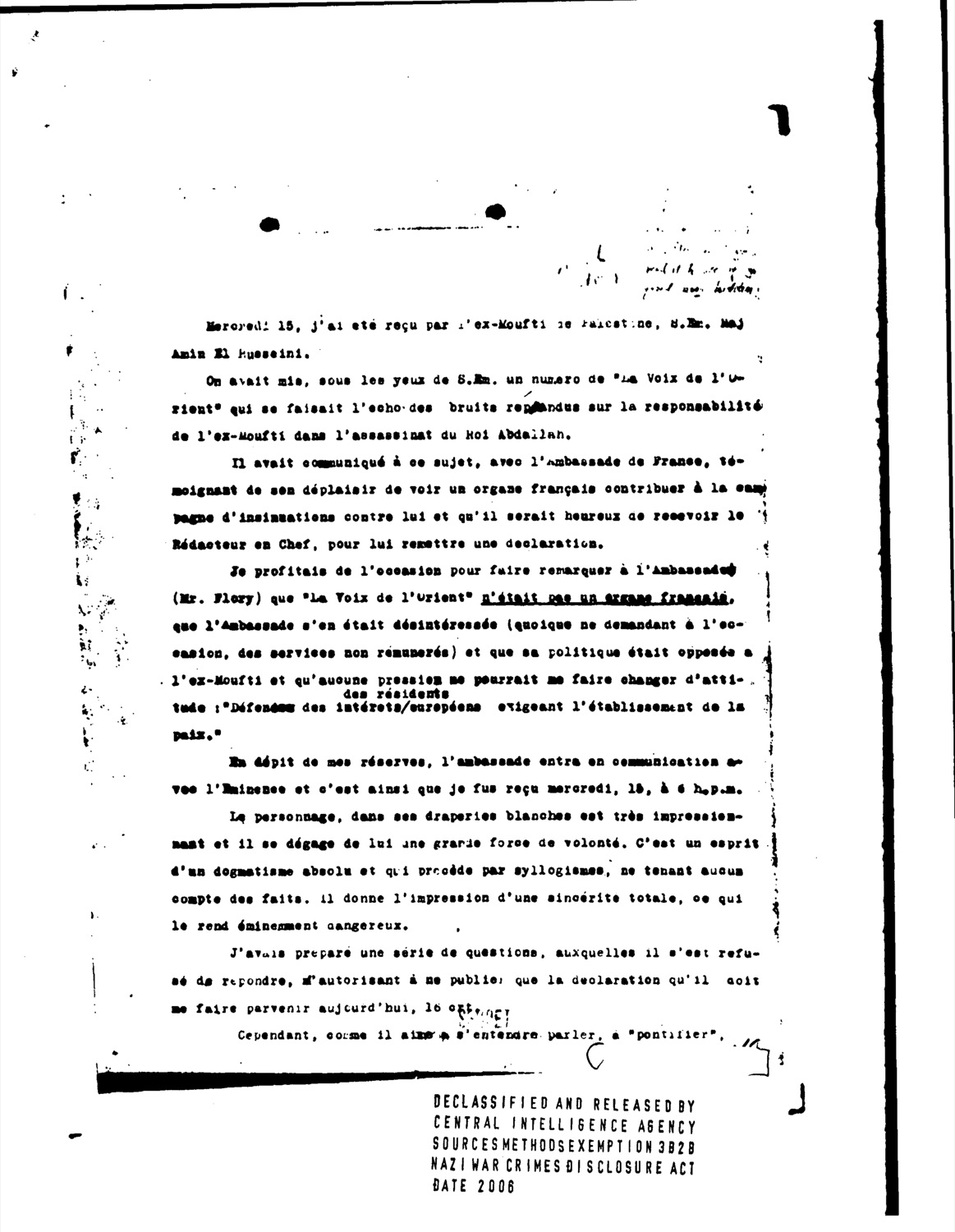
A French-language declassified CIA page recording an interview with Amin al-Husseini, with typed paragraphs, underlining, annotations, and a declassification stamp.
French account of an interview with Amin al-Husseini. Declassified CIA record from a working archive; not yet a published drop.
Canonical publication gives every drop a stable public form. A bounded drop becomes the stable, addressable release for its selection, sequence, thesis, interpretation, methods, and limitations.

Canonical means authoritative within this publishing system. It does not replace the originating source, archive, person, place, or community.

Bounded release

The drop states what belongs to the release, how it is ordered, and which questions and editorial claims organize it.

Stable address

One canonical URL connects sections, items, evidence layers, citations, methods, and later revisions.

Source-level return

Identifiers, provenance, archive references, page numbers, and evidence layers keep the release connected to its sources.

Validation

Pre-publication checks reject malformed metadata, broken references, unresolved rights decisions, inaccessible media, and incomplete evidence.

Several people are seen from behind with the Dome of the Rock softly out of focus beyond them.
A view toward the Dome of the Rock. Photograph by Levi Meir Clancy.
A man in a dark suit and cap is photographed in profile with the Dome of the Rock beyond him.
A portrait with the Dome of the Rock beyond. Photograph by Levi Meir Clancy.
Evidence must remain accessible. The same source should remain legible through more than one sense, language, device, or mode of navigation.

Accessibility is part of the evidence model rather than an optional visual treatment.

Images + descriptions

Selected images receive direct alternative descriptions, with the complete description layer kept nearby.

Audio + video

Public audiovisual originals include readable transcripts, and public video includes synchronized captions.

Language + translation

Language, reading direction, translation method, review state, and unresolved choices remain explicit.

Navigation + contrast

Structure, controls, focus, keyboard access, contrast, and resilient HTML keep evidence usable without depending on color or JavaScript.

Correction, restriction, and revision remain part of the record. The default is a traceable public record, not permanent exposure. Continued access never outranks consent, rights, dignity, privacy, or safety.

The response remains proportionate to the concern and can change as circumstances or understanding change.

Correct + append

Substantive corrections and changed interpretations receive dates, responsibility, and revision notes rather than silent replacement.

Restrict access

A file, layer, identifying detail, item, or complete release may be limited while a concern is reviewed or remains active.

Remove from publication

Material may be withdrawn when continued public access is no longer responsible or authorized.

Retain appropriately

A minimal private decision record may remain when lawful and safe; underlying material is not kept merely to promise permanence.